
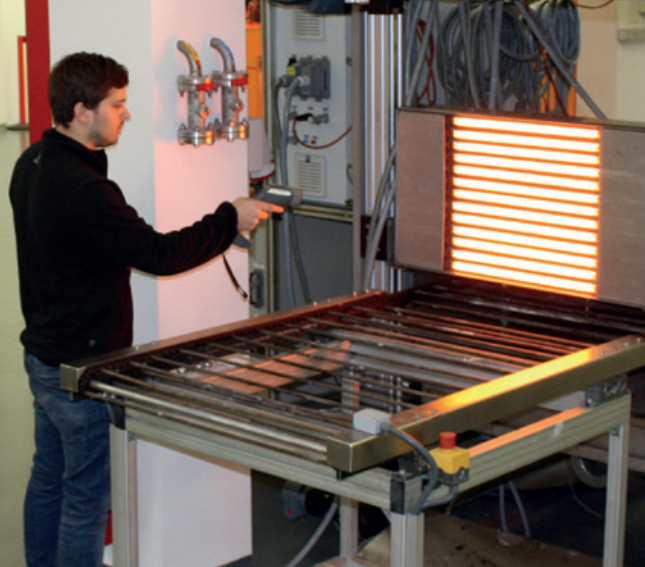
On the lithography floor, you can’t afford drift. A 0.3°C shift during photoresist bake is enough to scrap a full run of 300 mm wafers. You need heat that lands exactly where the process card calls for it—shift after shift, lot after lot. What matters under the hood We run a near infrared (NIR) emitter bulb that gives sub-millimeter uniformity by pairing a tight spectral output with reflector geometry that’s engineered, not guessed. The thermal field maps cleanly onto the wafer with minimal edge roll-off, so you stay inside tight thermal budgets. The response is in the milliseconds, which keeps temperature overshoot from creeping in. Repeatability is measured by lot: hit the same setpoint and you get the same film profile, batch after batch. The bulb sits comfortably in Class 1–100 cleanrooms with zero particle generation, and the long life makes maintenance windows predictable—no surprise downtime. Why it plays in process In photoresist processing, the NIR bulb locks down soft bake and hard bake—fast, even, and repeatable. That means consistent critical dimension, fewer reworks, and yield that doesn’t yo-yo. The energy density is high enough to shorten bake time without pushing peak temperature, so you cut utility draw while protecting the underlying stack. For wafer cleaning and drying, that same precision reduces thermal stress. Defect counts drop, and your defect specs stay inside the control limits. The practical details NIR heats line-of-sight, so mounting distance and angle have to match the chamber geometry. Expect a short warm-up to hit setpoint stability, and plan calibration intervals to keep the uniformity profile where it needs to be. Before you qualify a lot, confirm compatibility with your equipment interface and control strategy.